
SPECTRA Blog / Smart Home
Smart Home vs Intelligent Home — What Is The Difference?
A smart home responds to your commands. An intelligent home understands your patterns. The distinction is more important than it might seem, and it is reshaping how we think about property technology.
The Language Problem
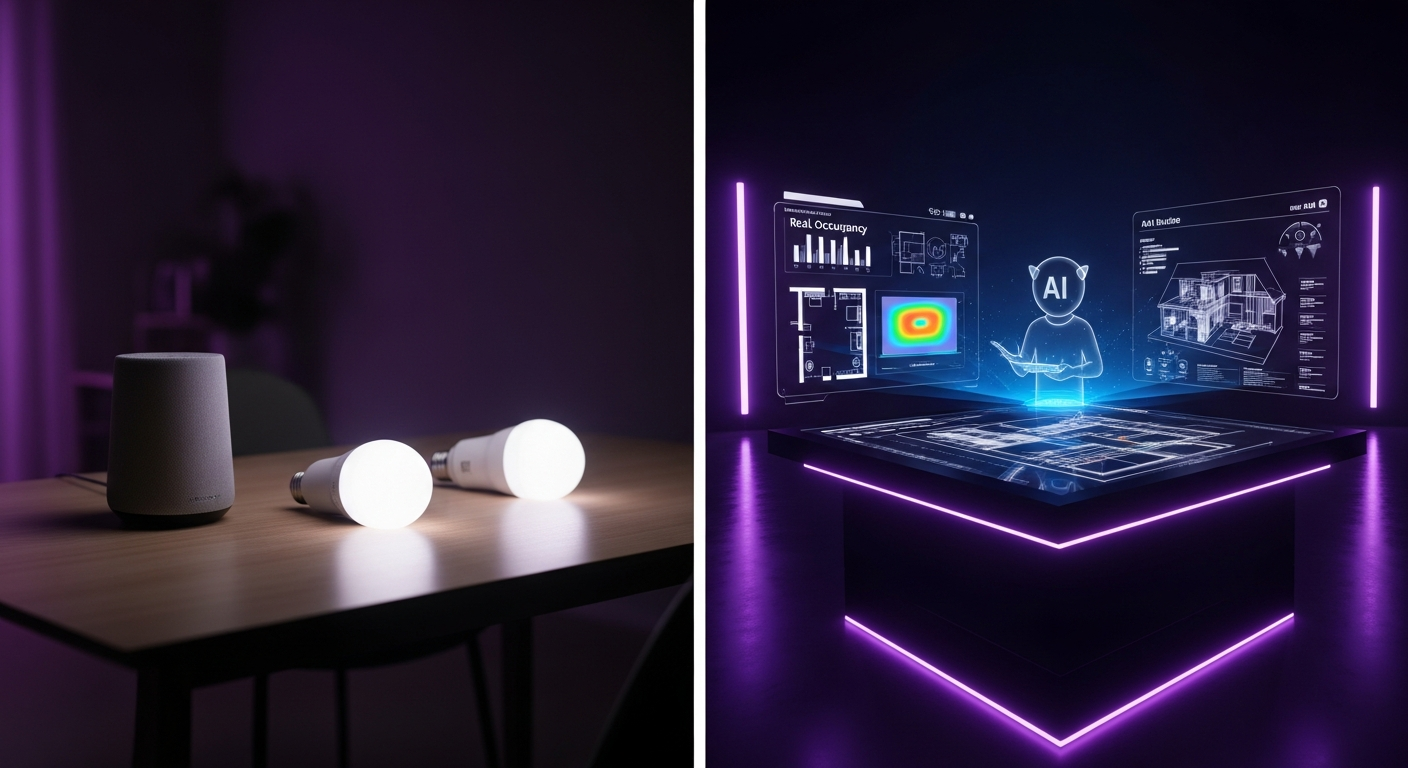
The term "smart home" has been applied so broadly that it has lost most of its meaning. A home with a voice-activated light switch is called smart. So is a home with AI-powered occupancy analytics, LiDAR mapping and a live digital twin. These are not equivalent.
The confusion matters because it affects how homeowners, architects and property professionals think about what technology can actually do for a building.
Let us draw a clearer distinction.
What A Smart Home Does
A smart home is fundamentally about remote control and automation. The defining characteristic is that a person — or a rule defined by a person — triggers an action.
Common smart home capabilities include:
- Adjusting lighting with a voice command or app
- Setting the thermostat remotely
- Viewing a live camera feed on your phone
- Programming appliances to run on a schedule
- Receiving alerts when a door is opened
These are genuinely useful features. But notice what they have in common: they are all reactions. A smart home does what you tell it, when you tell it. It does not observe, learn or understand.
What An Intelligent Home Does
An intelligent home observes. It accumulates data. It identifies patterns. It provides insight you did not know to ask for.
The defining characteristic of a truly intelligent home is that it understands the property — its geometry, how it is used, who is in it and how that usage changes over time.
Capabilities that distinguish a home intelligence platform:
- Occupancy awareness — knowing which rooms are occupied right now, without cameras
- Behavioural analytics — tracking how the home is used across days, weeks and months
- Digital twin — a live 3D model of the property that reflects reality in real time
- Anomaly detection — flagging when patterns deviate from established norms
- Space utilisation reporting — showing which rooms are used most and least
A Practical Comparison
| Scenario | Smart Home Response | Intelligent Home Response |
|---|---|---|
| You leave for work | Turns off lights you activated | Detects no occupancy, adjusts heating across all zones |
| Guest visits | No awareness | Detects additional presence pattern, logs to analytics |
| Dining room unused for a week | No awareness | Flags in space utilisation dashboard |
| Unusual 3am movement | Camera alert (if installed) | Occupancy anomaly alert, no footage captured |
| You want a floorplan | No capability | Generates accurate plan from LiDAR scan |
| Estate agent viewing | No additional value | Provides 3D walkthrough and occupancy analytics for listing |
Why This Distinction Matters For Property
For Homeowners
Control is a convenience. Understanding is an asset. Knowing how your home is actually used — which spaces deliver value, which sit empty, how patterns change across seasons and life events — helps you make better decisions about renovation, energy and property investment.
For Estate Agents
A home with a digital twin and documented space analytics is a more compelling property. Buyers can understand the layout in 3D, see evidence of the home's practical design and make informed decisions before viewing. This is a meaningful marketing advantage.
For Architects
Design based on how spaces are actually used produces better outcomes than design based on how clients assume they will use a space. Home intelligence data bridges that gap.
For Property Managers
Monitoring occupancy across a portfolio without cameras provides compliance and oversight capability that traditional smart home technology simply cannot offer.
The Privacy Advantage Of Home Intelligence
A smart home with cameras collects footage of your home and everyone in it. An intelligent home platform built on WiFi sensing and LiDAR mapping collects geometry and signal data — never images, never audio.
This is not just a privacy preference. It reflects a fundamentally different approach: understanding a space through the signals it produces, rather than watching it.
The Future Is Intelligent, Not Just Smart
The smart home market has matured into a commodity — connected devices are cheap, widely available and broadly adopted. The next wave of home technology is moving toward genuine intelligence: AI that understands properties, not just responds to people.
Platforms like SPECTRA represent this shift. The combination of LiDAR mapping, WiFi occupancy sensing and AI analytics creates a home that does not just obey commands — it understands the building it inhabits.
That is the difference between smart and intelligent. And it is a difference worth understanding.
Frequently asked questions
What is the difference between a smart home and an intelligent home?
A smart home lets you control devices remotely or through voice commands. An intelligent home uses AI and sensors to understand how the property is used, detecting occupancy, tracking patterns and providing analytics without requiring your input.
Can a home be both smart and intelligent?
Yes. SPECTRA adds a home intelligence layer to your existing property without replacing any smart home devices. Your existing automations continue to work alongside the occupancy intelligence and analytics SPECTRA provides.
Does home intelligence require replacing my existing smart home setup?
No. SPECTRA works alongside your existing smart home devices. It adds occupancy intelligence and analytics on top of whatever you already have installed.
Is home intelligence technology available now?
Yes. SPECTRA provides AI-powered home intelligence using the built-in LiDAR sensor in your iPhone and your existing WiFi router — no new hardware required.
Which is better for privacy — a smart home or an intelligent home?
An intelligent home platform like SPECTRA is significantly more private than camera-based smart home systems. SPECTRA detects occupancy through WiFi signal analysis and never captures images, video or audio.